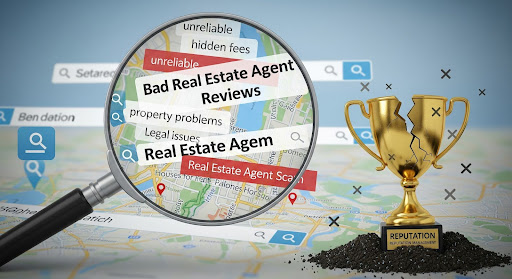

In real estate, a single Google search can shape perception before reviews even load. Buyers and sellers form opinions in seconds, guided less by testimonials and more by where an agent appears on the search results page.
This is the blind spot in real estate reputation management. Many agents invest heavily in reviews and testimonials, yet lose leads to competitors because search assumptions—not sentiment—drive first impressions.
The Power of Search Assumptions in Real Estate
Most buyers form an opinion about a realtor before clicking anything. Search layouts, map results, and visibility cues do the work for them.
When someone searches for a realtor:
- They see the local map pack first
- They notice position, proximity, and basic credibility signals
- They assume top-ranked agents are more trustworthy
This occurs before any review is read. Real estate reputation management now lives at the intersection of visibility and psychology, not just feedback scores.
How Google Shapes Realtor Perception
Google’s layout encourages snap judgments. The local map pack, knowledge panels, and featured elements dominate attention and capture most clicks.
Buyers tend to assume:
- Agents in the top map results are more established
- Visibility equals credibility
- Higher placement reflects better service
Zero-click searches reinforce this effect. Many users never reach review platforms or agent websites. Their perception is formed entirely within Google’s ecosystem.
For real estate professionals, reputation is often determined by ranking, not rating.
Why Traditional Reputation Management Falls Short
Traditional reputation management focuses on collecting positive reviews and suppressing negative ones. In real estate, that approach is increasingly ineffective.
A lower-rated agent in the top map position often receives more calls than a highly rated agent buried lower on the page. Search position overrides sentiment.
Worse, aggressive review suppression can backfire. Review gating and filtering violate platform and FTC guidelines, risking penalties and long-term trust damage.
Modern real estate reputation management must prioritize search presence, legitimacy signals, and sustained visibility—not just star counts.
Algorithmic Bias Beats Review Suppression
Google favors activity, relevance, and proximity. It does not reward hidden reviews or artificially controlled sentiment.
What works:
- Steady review velocity from real clients
- Consistent engagement and responses
- Complete, accurate business profiles
- Strong local SEO signals
What fails:
- Blocking negative reviews
- Inflating ratings through suppression
- One-time review campaigns
Search algorithms reward authenticity and momentum, not perfection.
Ranking Matters More Than Ratings
Search data consistently shows that the top organic or map result captures a disproportionate share of clicks, regardless of star rating.
A realtor ranked first with average reviews will often outperform a higher-rated competitor ranked lower. Buyers interpret ranking itself as a form of social proof.
This reality forces a shift in strategy. Real estate reputation management must start with ranking control and local visibility before reviews can even influence the decision.
The Risk of Being Absent in Search
An unclaimed or poorly optimized profile creates immediate doubt. Buyers often interpret missing or incomplete listings as a lack of legitimacy.
Absent or inconsistent profiles:
- Remove agents from local map results
- Push traffic to competitors
- Create negative assumptions before contact
Claiming and maintaining a complete digital footprint is no longer optional. Visibility is part of credibility.
Local Pack Dominance Beats Testimonials
Testimonials buried on websites or review platforms carry less weight than a strong local map presence.
The map pack:
- Appears above organic results
- Combines proximity, rating, and visibility
- Drives the majority of local realtor clicks
Agents who dominate the local pack shape buyer assumptions instantly. Testimonials still matter—but only after visibility is secured.
How Competitors Hijack Search Perception
Competitors can take control of search results through a mix of local optimization and paid search tactics. Even agents with strong reviews can lose ground if rivals dominate the top of the page.
Common tactics include:
- Bidding on competitor brand names
- Owning top map positions
- Combining ads with local SEO dominance
This creates the illusion of authority and reliability, regardless of actual performance.
Real estate reputation management must include monitoring and defense against this kind of SERP takeover.
Speed Influences Trust Before Reviews Do
Page speed and mobile performance play a silent but powerful role in reputation.
Slow-loading pages increase bounce rates and reinforce negative assumptions. Fast sites feel more professional and credible, even before content is read.
Google’s Core Web Vitals directly influence rankings, which in turn shape perception. Speed is now a reputation signal.
Buyer Psychology Favors Assumptions Over Analysis
Buyer behavior is driven by quick mental shortcuts:
- The halo effect makes top results seem superior
- Availability bias favors what appears first
- Ranking becomes a proxy for quality
Reviews still matter, but they are secondary. Search position frames the entire decision.
Real estate reputation management that ignores this psychology leaves agents vulnerable, no matter how strong their testimonials are.
What Modern Real Estate Reputation Management Requires
Effective strategies now focus on:
- Local SEO and map pack optimization
- Complete, consistent business profiles
- Authentic review generation and engagement
- Ongoing monitoring of search visibility
- Defense against competitor SERP dominance
When reputation issues extend beyond reviews into search perception, firms like NetReputation help agents identify visibility gaps, manage negative search narratives, and restore control over how they appear across search results.
Final Takeaway
In real estate, reputation is no longer shaped where reviews live. It’s shaped where search decisions are made.
Agents who win control of search visibility win the assumption battle—and often the listing—before reviews ever come into play.
Real estate reputation management today is about speed, presence, and positioning first. Sentiment follows after.