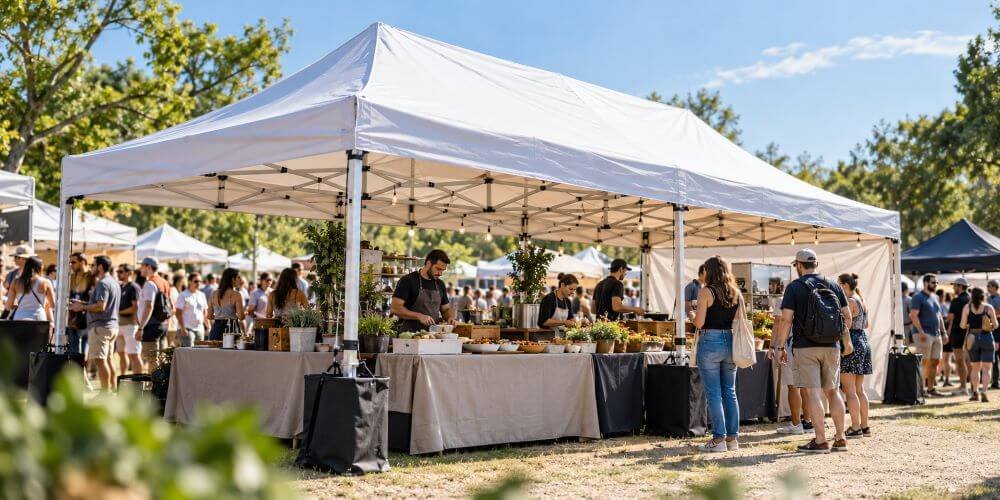

A canopy took off at a food festival near me a couple of years back. Not movie-style, nothing dramatic. It just shuffled sideways across the lot with two volunteers dangling off one leg while maybe forty people filmed it. No weights on it. Cheap frame. Guy lost his whole Saturday.
That’s the story people tell. The boring truth is most canopy failures don’t look like anything. A leg bends a little. A seam gives up in month three. The top fades after one summer, and suddenly your booth reads as a yard sale to everyone walking past.
Spending more isn’t really the fix either. Knowing what to look at is. There’s a real gap between custom tents built for event circuits and whatever’s stacked in a big-box parking lot each spring, and the gap isn’t always the price tag.
What Actually Matters When Picking an Event Canopy
-
Printing that survives the season
Dye-sub on polyester. If you remember one printing term, that’s the one. Screen printing isn’t useless; it just cracks faster on fabric that gets folded and refolded every weekend.
Full-wrap printing too. It covers seams and legs instead of leaving raw white panels showing from the sides, and from thirty feet away that white peeking out looks like you ran out of material.
Small thing, big embarrassment saved: get the top and sidewalls printed in the same batch. Colors drift a little between production runs. Attendees won’t know why your booth looks slightly wrong. They’ll feel it. Keep walking.
-
Frame material
Steel versus aluminum. That’s the whole decision, and nearly everyone makes it wrong because they pick with their hands.
Heavier feels stronger. Sure, in the store. At an event, frames have one job-killer: they rust once the powder coating chips, and the coating always chips, usually right at the joints. Aluminum and steel don’t. Costs more, weighs less, and ignores rain. Boring answer, correct answer.
Wall thickness on the legs, by the way. Under 1mm is decoration. Listings hide this on purpose a lot of the time. If it’s not stated, ask.
-
Wind, and what your tent is not
Not a storm shelter. Say it out loud once, because vendors have lost inventory and gotten sued for treating pop-ups like permanent buildings.
A heavy-duty frame still handles gusts that would fold a cheap one. Reinforced corners. Truss across the ceiling. Legs that don’t wobble when somebody leans on them. But weight? Weight does more for wind than frame quality ever will. Sandbags, water barrels, and stakes where the venue allows.
An unweighted good tent still travels. Across the fairground. In slow motion, for some reason. Never figured that part out.
-
Fabric rating
Photos lie. Every canopy top looks identical online.
Then August arrives. Denier count and UV treatment are the two things standing between your deep blue canopy and the strange washed-out lavender thing it becomes by September. And if there’s a logo printed on that faded fabric? Somehow worse than no tent at all. A tired-looking print tells everyone you don’t do this often. They pick up on it without knowing they’re picking up on it.
-
Size, layout, and where people exit
Bigger charges you twice. Once in the purchase, again in booth fees, since festivals often bill by footprint. A 10×10 custom pop-up tent handles most standard allocations fine. Map what you actually bring. Table, display, staff, somewhere for visitors to stand without blocking the aisle. Before assuming you need more.
Then think about exits. Feels odd to say, but crowd flow decides if a booth works or doesn’t. Three walls plus one open face pulls people through. Four walls turn it into a box, and people don’t enter boxes. They just don’t. Nobody knows why. They don’t.
-
Setup speed on a bad morning
You will arrive late someday. Traffic. A truck that didn’t show. A volunteer who slept through three alarms. Something.
When that morning comes, the tent two people can throw up in five minutes is worth more than the one four people wrestle with for twenty. Push-pin legs are fast but wear out. Pull-pins last, costing you muscle. And some branded tents aimed at serious circuit work come with crank or foot-pedal height adjustment. Sounds ridiculous until you’ve cranked a 10×20 frame up by hand in July. After that, cranks seem like friendship.
End Point
Frame first, fabric second, print third. And weigh it all against your real schedule. A tent going up twice a year needs nothing near circuit-grade, and paying for that durability is just money sitting in a garage. Buy for the calendar you actually have. The canopy outlasts the events that wore it in.