

In traditional search, high-quality backlinks have often been enough to keep a page near the top of Google long after it was published, with only occasional revisions. The AI engines now answering many of those same queries cite far more recent material. Pages cited this year by AI platforms and Google’s two AI surfaces had a median age of 468 days, roughly 22% younger than the pages in Google’s organic top 10, according to a six-month study of 2.31 million AI citations released in October 2026. The same research found that a typical page lost half its citations within about four and a half weeks.
Ahrefs found the same pattern in July 2025 across close to 17 million citations, with AI-cited pages averaging 1,064 days since publication against 1,432 days for organic results. Part of the reason lies in the models. When researchers added fake publication dates to otherwise unchanged passages in a September 2025 study, the dates alone pushed some passages up as many as 95 positions in rankings produced by seven LLMs, including GPT-4o. Search behavior compounds the effect: where ChatGPT and Perplexity displayed their background queries, 57% of those generated from statistics prompts included the current year.
ChatGPT Now Cites Recently Published Pages
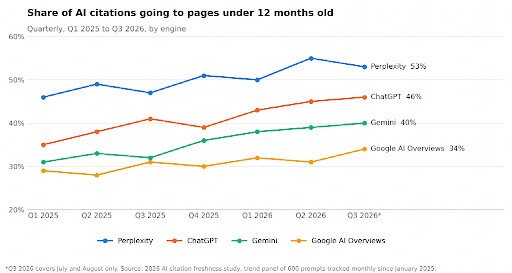
ChatGPT’s share of citations going to pages under a year old rose from 35% in early 2025 to 46% by the third quarter of 2026, the largest gain of any engine. Perplexity still cites the most recent pages, while Google AI Overviews gained only five points. ChatGPT citations also turn over fastest: a typical page loses half of them in 3.6 weeks, against 5.9 on Perplexity.
The median cited page was 38 days old for news queries, 214 days for pricing and product comparisons, and 1,284 days for definitions and explainers. Health and legal answers drew on older sources because engines rely on government agencies and professional bodies, which update their guidance less often. In practice, a software vendor whose buyers ask comparison questions needs to update its pages far more often than a firm publishing a guide to 1031 exchanges.
Updating the Date Has Minimal Effect
Among 3,140 URLs whose visible date changed while less than 5% of the body text was edited, citations rose 6% over the following four weeks. Pages with substantive revisions rose 31%. Pages updated within the past three months averaged about 63% more citations than those last touched earlier, a gap the researchers are careful to describe as correlation, and the advantage largely disappeared once a page passed the one-year mark.
For marketing teams, the findings change where content budgets should go. Original datasets, official documentation, and thorough explainers held their citations longest, largely because competitors cannot easily reproduce them. Commercial pages such as product comparisons and “best of” lists are different. They tend to appear in answers for buyers who are ready to purchase, and they now need revising every few weeks, with substantive changes like updated pricing or a newly launched competitor. A team that spends its budget only on new articles will see its best-cited pages gradually drop out of the AI answers its buyers read.